5 Incredible Benefits of Professional Hockey Lessons
Professional hockey lessons provide focused coaching on skating, puck control, shooting and game decisions, with feedback aimed at a player's current needs.
Progress in hockey is not measured only by goals scored or the speed of a player's stride. The sport asks athletes to balance on narrow blades, control a moving puck, recognize developing plays, and make choices in moments that offer little time to think. Over time, players often discover that certain parts of their game need more attention.

Professional hockey lessons offer a structured setting to address those needs with guidance and repetition. Whether a player wants to become more comfortable on their edges or make better decisions under pressure, focused instruction can connect individual technique to what happens during a game. The point is to make those skills more reliable when the pace of play increases.
1. Develop Stronger Skating Mechanics
Nearly every hockey skill depends on what happens beneath a player's feet. Trouble balancing through a turn can also affect puck control. An inefficient stride may limit how quickly someone reaches open ice or changes direction when play shifts. Improving skating mechanics therefore supports more than speed; it creates a steadier foundation for other parts of the game.
Some skating details are easy to overlook in the pace of team activity, but hockey lessons give coaches time to observe them closely. Edge control, crossovers, acceleration, and transitions each involve body positioning and timing that benefit from direct feedback. A coach may identify where a movement loses efficiency, then provide repetitions that help the player make a specific adjustment. Rather than treating skating as one broad ability, focused instruction breaks it into manageable skills.
This attention is particularly relevant as more young athletes enter the sport. According to USA Hockey's 2025–26 data, the U6–U8 age groups included 130,465 players, representing 3.4% growth over the previous year. Participation numbers do not determine any individual player's readiness, but they underscore the value of instruction that responds to different levels of experience. Building sound habits early gives developing skaters something dependable to carry into increasingly demanding situations.
2. Become More Comfortable Handling the Puck
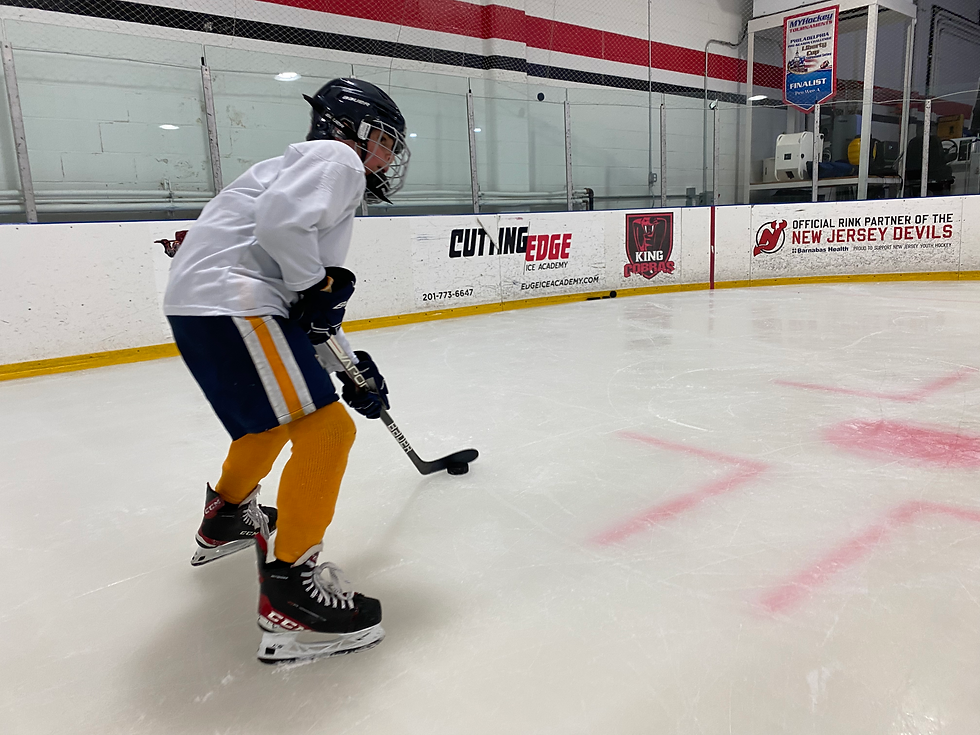
Good puck control involves more than keeping the puck close to a stick. A player may need to carry it through a turn, protect it from an opponent, or change direction without giving away the next move. These situations demand coordination between skating, stickhandling, and awareness. When puck movement feels uncertain, attention can narrow to the puck itself instead of the play unfolding around it.
Coached practice makes those details easier to isolate. Through hockey lessons, players can work on tight-area handling, fakes, and puck protection while learning why a move is or is not effective. For example, a change of direction becomes more useful when the player can maintain control while shifting weight and changing edges. Deception also depends on timing: a believable fake can influence how an opponent reacts, but only if the player remains prepared for the next movement.
The benefit is not simply a larger collection of moves. It is the ability to choose and execute a useful action while maintaining composure. With guided repetition, players can become more familiar with how their hands, feet, and eyes work together, making puck possession less distracting and leaving more attention available for the game itself.
3. Improve Decision-Making During Games
Hockey rarely presents a single obvious choice. A player approaching traffic might have room to move, an opportunity to shoot, or a reason to support a teammate instead. Knowing how to skate or handle the puck is essential, but applying those abilities requires awareness of positioning, pressure, and available space. Strong game habits help players recognize what a situation calls for rather than acting on instinct alone.
During professional hockey lessons, attention to hockey IQ and small-area play can connect technique to the choices players actually face. Players also learn to notice how pressure changes the options available. A coach can help a player understand why one option is effective in a particular situation and why another closes off space. Attention to support positions and the timing of a move allows technical skills to serve a purpose. A player who holds possession for an extra moment may give a teammate time to move into support, while forcing a play can surrender that advantage. Even a well-executed maneuver can produce a poor result when used at the wrong moment.
Learning to read a play also changes how players interpret mistakes. Instead of viewing a lost puck or missed opportunity as a single failure, they can examine the decision that preceded it. Feedback can bring those patterns into focus, helping players develop habits they can recognize and adjust during future games.
4. Make Shooting More Consistent and Intentional
A powerful shot is not necessarily an effective one. Release timing, accuracy, body position, and the choice of when to shoot all influence whether an attempt creates a meaningful scoring chance. A player who can shoot accurately while standing still may discover that the mechanics feel different when moving at game speed. A high volume of attempts alone may not refine those details. Targeted hockey lessons offer room to examine how a shot is taken, not just whether the puck reaches the net.
In shooting-focused sessions, instruction can address the relationship between technique and the situation. Coaches may work on releasing the puck in stride, directing shots more accurately, or identifying moments when a quick release is useful. Feedback helps players understand which part of a motion needs attention, while repeated attempts provide room to apply that correction. Instead of practicing every shooting element at once, a session can concentrate on the habits most relevant to the player's current needs.
Purposeful shooting practice also encourages better shot selection. Recognizing available space and preparing the puck for a controlled release connects scoring technique with decision-making. As those elements become more familiar, players have a stronger basis for choosing how and when to finish a play.
5. Build Confidence Through Focused Feedback
Confidence in hockey is more useful when it grows from understanding what to do than from simply being told to feel assured. Hesitation may follow an unstable transition, a mishandled puck, or a missed opportunity the player cannot explain. Identifying the specific issue makes improvement less abstract. A clear training goal gives the player something concrete to work toward.
Private hockey lessons allow a coach to concentrate on one or two priorities, offer immediate corrections, and adjust repetitions around the player's development. Skill-specific clinics provide another format, bringing players together for coached practice in a defined area such as edges, stickhandling, or shooting. These settings differ in structure, but both can give players dedicated attention to skills that may receive less emphasis during regular team activity.
Progress is rarely identical from one session to the next. Some adjustments become familiar quickly; others require repeated feedback before they hold up when the pace increases. Learning what an improvement feels like and recognizing it during play can gradually replace hesitation with more deliberate action. That is a meaningful form of confidence because it rests on skills the player is actively developing.
Improvement in hockey often comes from paying closer attention to the small decisions and movements that shape a player's experience on the ice. With clear goals and constructive coaching, practice can become more purposeful without losing the enjoyment of playing. At Cutting Edge Ice Academy, we offer private lessons and skill-focused clinics that help players work on the parts of their game they want to strengthen. We invite families to explore our available sessions and choose an option that fits their player's development goals.
Find Hockey Lessons in Elmwood Park
Families in Elmwood Park and across North Jersey can review private hockey lessons and the weekly clinic schedule to compare training options. Check current program details for age fit, coaching focus and availability.